
USDA Makes Modest Cut to Corn Yield 🌽

VOTE NOW
Coolest Thing Made in MI
MMPA’s low-carbon, dairy-based ethanol has been nominated for the 2026 Coolest Thing Made in Michigan People’s Choice Award. Made in Constantine, this ultra-low-carbon fuel transforms milk permeate, a byproduct of processing ultrafiltered milk, into renewable energy. The innovative process, created in partnership with Dairy Distillery, creates new value from milk while reducing carbon emissions and opening new possibilities for renewable energy and sustainable aviation.
Vote for us daily at micoolestthing.org
MARKET NEWS USDA
Makes Modest Cut to Corn Yield 🌽
Daily Dairy Report | September 11, 2026
This year’s corn harvest won’t be quite as large as last year’s bin-busting crop. But thanks to massive acreage and decent yields, USDA expects the 2026 corn crop to be the second-largest on record. In its monthly update to the World Agricultural Supply and Demand Estimates (WASDE) and Crop Production reports, USDA pegged the average corn yield at 178.5 bu. per acre. That was substantially lower than last year’s recordsetting 186.5 bu. and 2.2 bu. below August’s estimate.
Traders on LaSalle Street had anticipated the cut. Corn futures jumped in mid-August when Pro Farmer crop scouts toured the Corn Belt and projected a significant drop in yields compared to the prior season. USDA’s weekly crop condition ratings and anecdotal reports from farmers confirmed that drought in the Plains and dry conditions in the northwestern Corn Belt withered yields in those regions. In today’s report, USDA forecast a 28-bu. per acre drop in North Dakota’s corn yield, with yields off 26 bu. in South Dakota, 24 in Kansas, 22 in Oklahoma, 21 in Texas, and 17 in Nebraska. Most Corn Belt states are expected to suffer a 4-5-bu. decline in corn yields compared to last year. However, USDA called for a 9 bu. jump in Iowa’s yield, and conditions improved in the eastern CornBelt. The agency expects average corn yields in Ohio and Pennsylvania to best last year’s by 9 bu. and 14 bu., respectively.
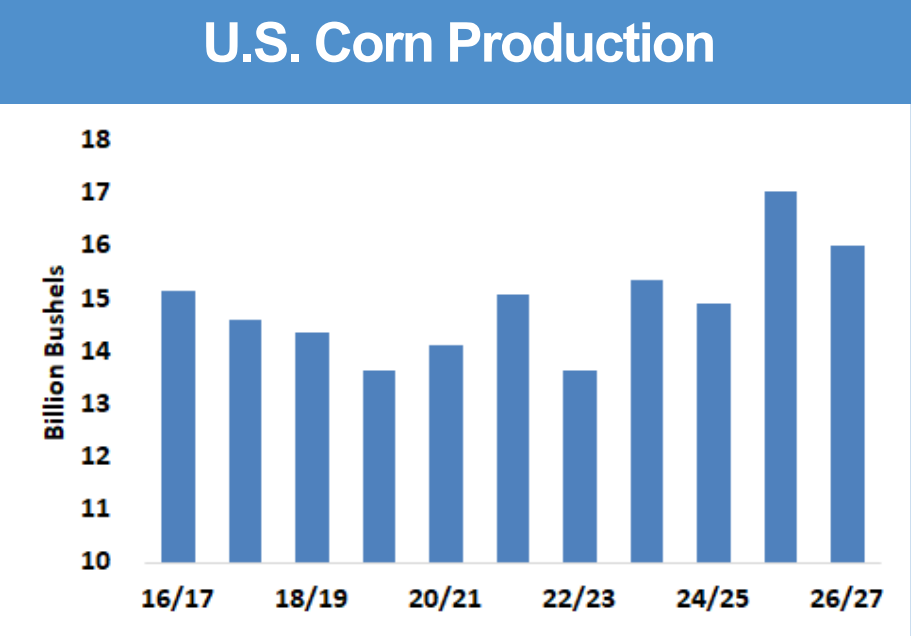
Farmers planted 96.8 million acres of corn this year, the second-highest acreage in more than a decade. USDA projects that this abundant acreage and variable yields will add up to 15.8 billion bushels of corn. While that is 7% smaller than last year’s total, it is otherwise the largest corn crop on record. USDA expects domestic demand and exports to be second only to last year, with end-of-season corn inventories to drop a substantial 18.5%, from 1.92 billion bushels on Sept.1 to 1.57 billion bushels by Sept. 1, 2027. Tighter stocks will mean higher prices, but this year’s harvest may be large enough to forestall a return to the recent peak in the corn market. DEC corn futures retreated today and closed at $5.32/bushel.
August rains benefitted the soybean crop during the crucial pollination period. USDA’s soybean yield estimate inched up to 52.8/bu. per acre, slightly lower than last year’s average of 53 bu. Thanks to higher acreage, this year’s soybean crop is projected to be the largest ever. Demand will be big too, as soybean processors rush to crush as many beans as possible. High energy prices and generous tax credits for renewable fuels have boosted demand for soybean oil. Production of soybean meal will be record-large in the 2026-27 crop year. Nonetheless, soybean meal stocks will likely hold steady year-to-year as both domestic and export demand grows. Soybean meal futures remain lofty, with the DEC contract closing at $354/ton.
Today’s price retreat is helpful, but dairy producers are still bracing for much higher feed costs than those that prevailed over the past three years. That’s going to hit especially hard in cheese states. So far this year, Class III prices have ranged from $14.62/ cwt. in January to $16.92 in May. And futures project more $16 milk checks for Class III producers, which may not be enough to pay the bills with corn prices north of $5/bu.
NMPF NEWS ALERT
- Last week, NMPF joined the International Dairy Foods Association and 76 dairy companies, cooperatives, and state and regional farmer organizations in sending a letter to congressional leaders urging them to reject S. 5026, the Childhood Diabetes Reduction Act of 2026. The bill would create a sweeping definition of"ultra-processed foods" and require as many as four different front-of-package warning labels on products that fall under it, including whole milk, cheese, most yogurts and other cultured dairy products.
The farm bill’s existential crisis
PoliticoPRO – Sept. 14
The farm bill’s power to rally bipartisan coalitions in Congress is weaker than it’s ever been — and Republicans are running out of time to make the measure relevant again on Capitol Hill. What was once a must-pass package of agriculture and nutrition policies updated every five years is now niche backburner work for most lawmakers. After years diverging Republican and Democratic priorities, the bill is expected to limp into a fourth year of stopgap extensions.
Canada forges new trade relations amid trade war
Agri-Pulse Daybreak (Starts at 06:47) – Sept. 14
Canada is working to build trade relations outside of the U.S. amid the ongoing trade war that has placed a strain on relations between the two nations. Canadian Prime Minister Mark Carney said the Canada Investment Summit will bring together investors from around the world. The summit will take place Sept. 14 and 15 in Toronto, Ontario.
Diverse Wisconsin dairy operations featured on WDE tours
Wisconsin State Farmer – Sept. 14
Visitors attending World Dairy Expo will have an opportunity to see a diverse cross-section of Wisconsin dairy farming through a series of afternoon farm tours scheduled Sept. 30 and Oct. 1. The tours will run from 12:15 to 6 p.m. each day during Expo week and will feature visits to four dairy operations showcasing different production systems, breeding programs, technologies and management philosophies.







.png)


