
Beef Industry Restructures 🥛
MARKET NEWS
Beef Industry Restructures 🥛
Daily Dairy Report | August 21, 2026
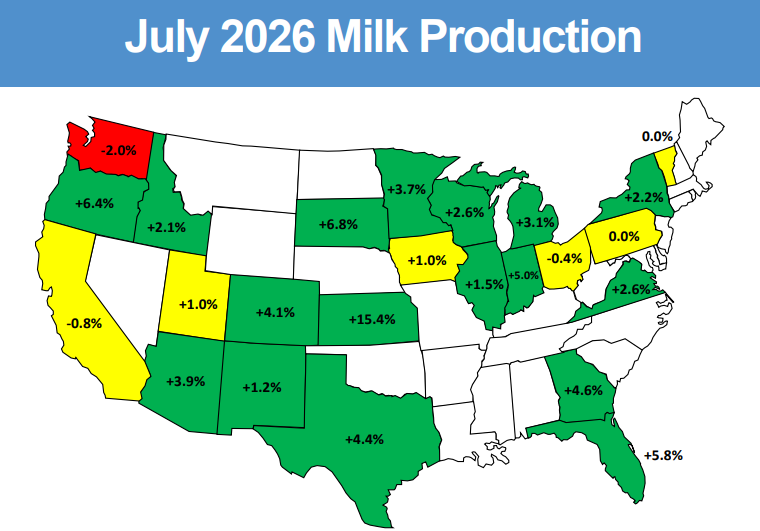
U.S. milk production expanded again in July, compounding extremely strong growth last year. Dairies across the country produced 20.145 billion pounds of milk in July, 2.2% more than in the same month last year, according to this afternoon’s Milk Production report. USDA also revised June output significantly higher on larger cow numbers, putting June’s estimated year-over-year production up 3%. July’s strong production is a testament to continued growth in the U.S. milk supply.
USDA estimates that a whopping 9.71 million dairy cows were in the national herd in July. This is unchanged from the prior-month’s revised figure but represents an astonishing 199,000-head increase compared to the same month last year and continues to be the largest herd size in more than 30 years. Rising cow numbers have been one of the key drivers pushing production upward as strong beef values have encouraged producers to keep cows in the herd for an extra lactation cycle. Even as beef values have weakened in recent weeks, they remain elevated historically and continue to be an important driver of producer decision making.
While the expanding herd was the main driver of the overall production increase, yield growth also contributed, albeit modestly. Average yields were up just 0.13% year over year in July. Extremely hot temperatures likely weighed on yields as producers across the country confronted summer conditions.
Smoke from wildfires could also have had a negative impact in parts of the country. While not considered in USDA’s Milk Production report, the percentage of useful solids in raw milk has also continued to increase, further stretching the potential of the U.S. milk supply.
In a continuation of the recent months’ trend, nearly every key dairy state reported volume growth in July with one key exception. Production in California, the largest dairy state in the country, fell 0.8% year over year in July. A 0.7% decline in the milk yield primarily drove the dip. However, a 1,000-head decline in the state’s milking herd also contributed to the loss. Outside the Golden State, volumes were up, with Wisconsin, Idaho, Texas, and New York posting gains of 2.6%, 2.1%, 4.4%, and 2.2%, respectively.
Rising milk production will translate into increased production of most dairy commodities, which will likely keep downward pressure on prices if demand remains unchanged. Robust exports have played a key role in preventing inventory accumulation, especially for cheese and butter, but additional demand growth will likely be necessary to prevent the market from becoming oversaturated with product.
Most dairy products found enough traction to move higher at the CME this week. Perhaps most notably, the spot price for nonfat dry milk (NDM) netted another 5.5¢, ending the week at $1.80/lb. with 41 loads trading hands. Another 60 loads of butter moved this week and the price rose 0.25¢ to $1.4625/lb. Cheese was the only product to lose ground, falling 7.25¢ to end Friday’s session at $1.5275.
NMPF NEWS ALERT
- NMPF's Regulatory Register covered screwworm response, FDA antimicrobial guidance, and dairy trade and labeling advocacy, while 80 evaluators gathered in Boise for the FARM Program's annual conference on stewardship and screwworm preparedness.
- NMPF members are invited to join the Q3 Milk Check-In on Wednesday from 2-3 p.m. ET, a casual update on market conditions, school nutrition policy, ag labor, trade agreements, New World screwworm preparations and more. Registration is required.
NMPF, USDEC thank Administration for maintaining pressure on Canada to resolve USMCA dairy concerns
NMPF, USDEC – Aug. 24
NMPF and the U.S. Dairy Export Council expressed their strong appreciation to the Trump Administration for its continued focus on using all available trade tools to resolve outstanding USMCA dairy market access issues with Canada. With a 50 percent tariff on certain Canadian imports taking effect on Saturday, the organizations urged Canada to return to the negotiating table and prevent further escalation.
Mexican ranchers prepare to resume livestock sales to U.S. under tight controls over screwworm risk
Associated Press – Aug. 22
The U.S. is set to resume Mexican cattle imports Aug. 24 at the Douglas, Arizona crossing, ending a yearlong ban imposed over New World screwworm concerns that strained cattle industries on both sides of the border. The reopening comes with restrictions to prevent the parasite's spread, even as Sonora, Mexico, reported its first screwworm case this week and the pest continues to be found in Texas and New Mexico.
Why dairy processors are all-in on America’s protein future
Dairy Herd Management – Aug. 21
Dairy processors are pouring $13 billion into new and expanded manufacturing capacity across 19 states, marking the industry's largest investment wave in decades. The buildoutreflects a bet on rising global demand for dairy protein and is reshaping the footprint of American agriculture.






.png)


