
Mexico’s Dairy Market Expands🌎
MARKET NEWS
Mexico’s Dairy Market Expands🌎
Daily Dairy Report | May 29, 2026
Mexico’s dairy sector in 2026 is enjoying renewed momentum as production, consumption, and trade patterns adjust to improved weather conditions, evolving consumer preferences, and expanding government nutrition programs, according to a recent report from USDA’s Global Agricultural Information Network (GAIN).
Following several years of drought and high feed costs, Mexican producers are expected to increase milk production by 2% percent in 2026 to 14.1 million metric tons (MMT), slightly less than Wisconsin. Improved soil moisture has supported pasture growth, and large-scale commercial farms in the northern and central parts of the country have increased yields as more dairy operations adopt precision feeding and advanced genetics. Improved cold chain technology at the farm-level has also helped lessen post-production losses.
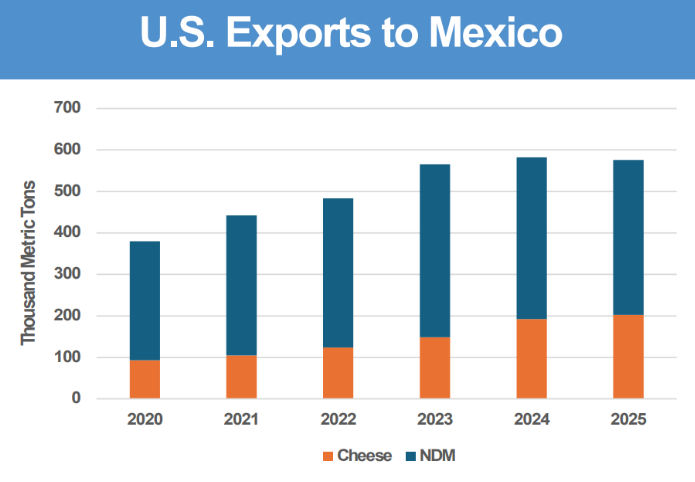
Despite these gains, producers continue to face elevated costs. Inflation reached 4.45% in April 2026, and energy prices remain roughly 20% above 2024 levels, raising overhead for producers and processors alike. Water scarcity in northern states as well as rising fuel and gas prices are also tightening margins even as production expands.
With a population of 130 million, Mexico is an attractive market with an estimated 8 million to 9 million high-income earners and another 15 million to 25 million middle income and aspirational consumers who have a high level of interest in imported products. Milk consumption is forecast to increase 2% in 2026 as urbanization shifts consumer behavior away from milk powder and toward fluid milk. Demand for high protein dairy products—cheese, yogurt, and fortified milks—will also grow.
Government intervention remains a major driver of consumption. The Leche para el Bienestar program aims to expand from 6.3 million to 10 million recipients by 2030 and plans to distribute nearly 800 million liters of subsidized milk in 2026. The program sells a liter of milk for 7.5 pesos, the equivalent of 45 cents.
USDA’s Gain report forecasts that Mexico will import 49,000 MT of fluid milk in 2026, up 7% from 2025, driven by industrial processors with specific milk solids specifications.
Transporting domestic fresh milk from northern Mexico’s milk pools to the southern tourist centers is more expensive than importing ultra-high temperature (UHT) or processed milk from the United States. Imports of cheese and nonfat dry milk (NDM) are forecast to increase by 3% and 5%, respectively. Continued growth in quick-service restaurants is also driving demand for industrial quantities of melting cheeses. With record tourism levels anticipated as Mexico prepares for the World Cup, the hospitality industry is preparing by procuring more domestic and imported cheeses.
To date, the United States has enjoyed unfettered access to Mexico’s dairy market and accounts for 75-80% of Mexico’s dairy imports. Exports to Mexico have represented more than half of all U.S. cheese and more than one-third of NDM exports.
Recently key dairy exporters, including the European Union, Australia and New Zealand, have gained favorable market access to Mexico, with phased-in tariff reductions and quota allowances. For example, Mexico and the European Union signed the Modernized Global Agreement and an Interim Trade Agreement on May 22, 2026, which allows for duty-free entry for up to 50,000 MT of milk powder, 25,000 MT of cheese, and 2,500 MT of butter over five years. However, in the first year of the Mexico-EU trade agreement, duty-free access is available for 30,000 MT of milk powder, 5,000 MT of cheese, and 1,500 MT of butter.
Still for 2026, and hopefully much longer, Mexico will continue to rely heavily on U.S. dairy imports even as new trade agreements introduce more competition.
NMPF NEWS ALERT
- Last week, NMPF joined the U.S. Dairy Export Council in calling on the U.S. Trade Representative to address Canada’s unfair dairy trade practices during the upcoming USMCA joint review. That push comes after a new U.S. International Trade Commission report confirms what U.S. dairy farmers have said for years: Canada’s dairy system creates a built-in surplus of nonfat milk solids, then lets processors buy those ingredients at artificially low prices.
- Today is World Milk Day and the first day of National Dairy Month! The House is set to vote this week on a budget that would reduce federal ag spending by 3% in fiscal year 2027. USDA Secretary Rollins is set to testify before the House Ag Committee on Thursday. The Senate convenes at 3 p.m. today, the House at noon on Tuesday.
CEO's Corner: AI conversation critical for dairy’s future
NMPF – June 1
I was first introduced to the possibilities of computer-generated data during high school in the 1980s. I later thought it was cutting edge to turn in my grad school homework on a 3 ½”, 1.44mb disc in the early 1990s. That felt like dizzying technological progress then. That’s nothing compared to now.
Screwworm found within 31 miles of U.S. border, says USDA
Reuters – May 29
A devastating parasitic fly that eats warm-blooded animals alive and could cause millions of dollars in economic damage to the U.S. economy has been found in a young sheep in Mexico within 31 miles (50 km) of the U.S. border, the U.S. Department of Agriculture reported on Friday.
Record dairy exports offset rising milk production
edairy news – June 1
Strong international demand is helping absorb expanding milk supplies, preventing inventory buildups despite robust global production growth. U.S. dairy production continued its upward trajectory in April, growing approximately 2.8% year over year and surpassing Ever.Ag’s earlier forecast of 2.1%. The stronger-than-expected increase reflects a broader global trend, with milk production also rising sharply in key exporting regions such as Europe and New Zealand.
EPA Administrator Lee Zeldin on MAHA, year-round E15, RVOs
Agri-Pulse – May 31
Many row crop farmers are concerned about having access to a wide array of crop protection tools. EPA Administrator Lee Zeldin joined the show to explain the shrinking backlog of approvals and how the agency will continue to engage with the Make America Healthy Again movement. Zeldin also discusses the future of the Renewable Volume Obligations, year-round E15, and if the Renewable Fuel Standard needs reform from Congress.






.png)


