
Headlines Batter Volatile Cattle Market🐮
MARKET NEWS
Headlines Batter Volatile Cattle Market🐮
Daily Dairy Report | May 15, 2026
Cattle futures swung wildly back and forth this week as geopolitical headlines buffeted LaSalle Street. On Monday, the Trump administration prepared an executive order to suspend over-quota tariffs on U.S. beef imports, hoping to restrain runaway prices in the grocery aisle. The policy was expected to boost U.S. imports of Brazilian beef, which currently suffer a 26% border tax. But just hours after the Wall Street Journal published news of the impending order, the Trump administration delayed it amid pressure from senators from ranching states. The drama continued Thursday. In a show of goodwill ahead of the summit between U.S. President Trump and Chinese President Xi, Beijing moved to restore import licenses to the more than 400 U.S. beef plants who had lost the privilege between March 2020 and April 2021 through China’s failure to renew lapsing certifications. But while China’s customs office briefly showed import licenses as “effective” early Thursday morning, they reverted to “expired” within a few hours. This afternoon, the U.S. Meat Export Federation said China had once again renewed the licenses.
The back-and-forth announcements battered a cattle market already on edge. Consumers are starting to balk at high beef prices, but the values reflect a structural shortage. The beef cow herd is at a 65- year low after years of drought in the West. Approximately 75% of the U.S. beef cow herd is in an area stressed by moderate drought or worse, so ranchers must keep head counts low to ensure enough grass per animal. Fewer cows and heifers inevitably mean fewer calves, and the 2025 beef calf crop was the smallest since 1941. In the past, feedlot operators who purchased young stock from ranches would import some livestock from Mexico to keep their pens full. But the U.S. suspended live cattle imports from Mexico due to outbreaks of New World screwworm. The ban, put in place a year ago, is preventing the typical annual import of 1.2 million Mexican feeder cattle.
Despite the acute shortage of cattle, beef is not scarce. Americans will have access to a record-high 30 billion pounds of beef this year as the industry responds to powerful market forces. Notwithstanding punitive over-quota tariffs, USDA predicts U.S. beef imports at a record-high 6.1 billion pounds. International buyers can’t stomach our sky-high prices, so U.S. beef exports will drop to an 11-year low. And cattle growers are keeping cattle on feed for as long as possible, packing on the pounds to make up for the shortage of young livestock. Figures from the week ending May 2 show there were 978 pounds of beef on the average steer carcass. That is 40 lbs. more than the same week a year ago and up 10%, or 87 lbs., from the same week five years ago. But those heavy cattle produce a lot of marbled beef and less lean beef. Meanwhile, protein-hungry consumers increasingly prefer lean ground beef. Ground beef consumption per capita is at a 21-year high as of last year.
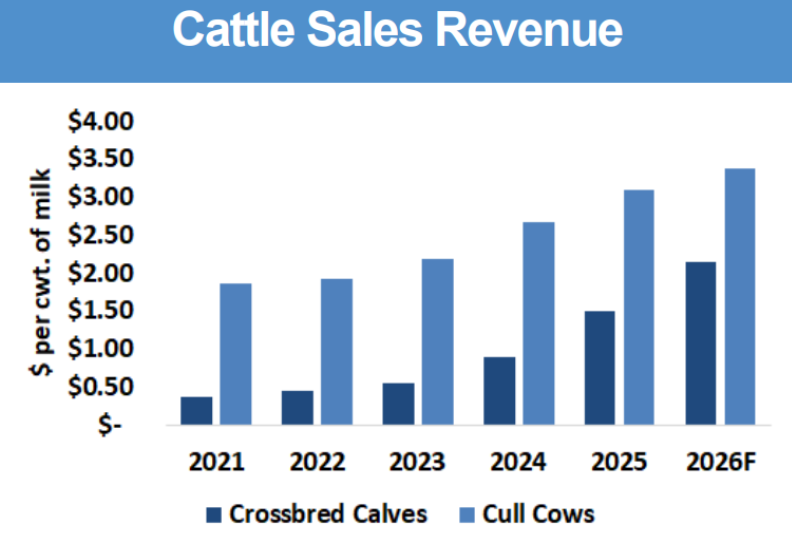
The dairy industry is uniquely positioned to supply the two things – lean beef and young livestock – that the beef industry so desperately needs. Dairy cull cows are an excellent source of lean beef, and beef packers are paying hefty prices for every one of them. While beef cows are in short supply, the milk-cow herd is larger than it has been in three decades, and an increasing number of those milk cows will carry a dairy-beef crossbred calf destined for a feedlot. Cull cow and beef calf sales are adding up to massive revenues for dairy producers. A dairy operation that seeks a 50/50 mix of dairy heifers and crossbred beef calves can expect to recoup $5 or $6 per cwt. of milk production in cull cow and beef calf revenue, up from about $2 five years ago. That income will likely fund expansion and shield producers from the brunt of a painful downturn in milk prices. These “cash cows” are setting the stage for even more growth in U.S. milk output.
NMPF NEWS ALERT
- The House on Tuesday passed the bipartisan Combatting Organized Retail Crime Act (CORCA), a bill aimed at cracking down on organized retail theft and cargo break-ins that have been creating headaches for U.S. dairy exporters.
- Sponsorship opportunities are now open for the dairy Joint Annual Meeting, happening Oct. 19–21 at the Gaylord Palms Resort & Convention Center. Many of the opportunities are first-come, first-served, so interested partners are encouraged to jump in early before the Sept. 1 deadline. For more information, contact Casey Kinler.
U.S. farmers turning to automation amid labor shortages
Associated Press – May 16
As the U.S. agricultural workforce shrinks and ages, farmers are increasingly adopting artificial intelligence and robotic systems to manage everything from weed control to dairy production. New York dairy Farmer Amos Coon said the robots have helped during the labor shortage and have also helped with herd health and cow comfort.
China to buy at least $17 billion in ag products, White House says
Agri-Pulse Daybreak (Starts at 0:23) – May 18
Details of what President Donald Trump and Chinese President Xi Jinping agreed to around agricultural market access continue to trickle out. Over the weekend, the White House said Beijing would buy at least $17 billion in U.S. ag products annually through 2028, in addition to the 25 million tons of soybeans it committed to in October.
More money in milk checks after rough start to 2026
Farm Progress – May 18
Butter and nonfat dry milk started 2026 in a slump and dragged dairy milk checks lower, but a recent rebound pushed Class IV milk prices higher. According to Corey Geiger, lead dairy economist at CoBank, June Class IV futures climbed nearly $7 per cwt to reach more than $22 in May trading activity on the Chicago Mercantile Exchange.
Indiana dairy producers carry on Indy 500’s historic milk tradition
Brownfield Ag News – May 15
For more than 20 years, the American Dairy Association Indiana has selected two dairy producers to meet the winner of the Indianapolis 500 in Victory Circle with a cold bottle of milk. Brian Rexing, NMPF Chairman and a fourth-generation dairy farmer from Owensville, Indiana is the 2026 Rookie Milk Presenter. He says he’s honored to present the coolest prize in motorsports to the winner’s crew chief, mechanic, and team owner.






.png)


