
Foodservice Could Struggle in 2026 🍽️
MARKET NEWS
Foodservice Could Struggle in 2026 🍽️
Daily Dairy Report | January 9, 2026
Foodservice sales in 2025 posted their second-slowest growth in a decade—surpassed only by 2020—and 2026 is not expected to improve significantly. High menu prices and ongoing economic uncertainty have made consumers more cautious, particularly those on the lower end of the economic spectrum.Growth in foodservice sales is projected to continue at a modest pace in 2026, with real year-over-year growth expected at 1.1%, slightly higher than 0.9% in 2025. According to a new report from Nestlé, sustained pressure from food and labor costs, combined with evolving consumer preferences, will require foodservice operators to anticipate change rather than react to it.
Americans are increasingly focused on what—and how much—they eat. The report found that 30% of consumers say they are more likely to eat healthy foods today than a year ago, a trend that should benefit dairy. However, many consumers are also eating smaller portions at meals and while snacking. Dining frequency has declined as well, with 23% of consumers saying they are more likely to celebrate special occasions at home rather than dining out.
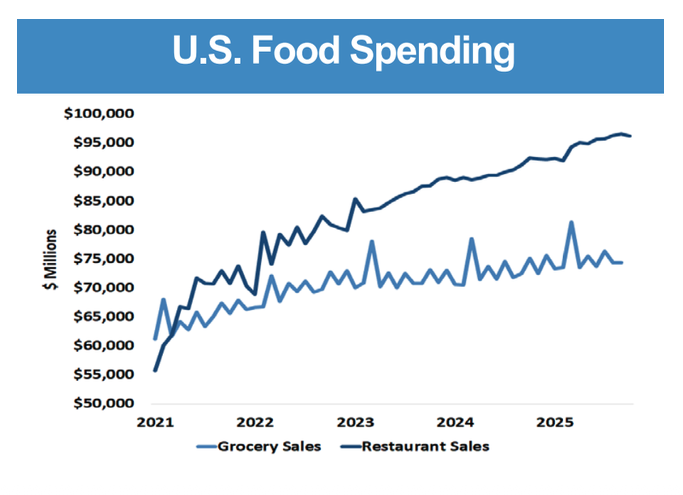
When consumers do go out, they are seeking something different—not just in food and beverages, but in overall experience. Global cuisines such as sushi, Pad Thai, and Korean BBQ rank high in interest, although these cuisines tend to be lower in dairy use.
At the same time, interest in comfort foods is growing, creating opportunities for dairy to play a leading role. The shift toward eating at home more frequently presents both challenges and opportunities for foodservice providers.
“Operators can draw guests back to dining out by offering experiences they simply can’t replicate at home,” the report notes. Consumers are looking for spaces that make it easy to gather, talk, and spend time with friends and family. Designing environments that encourage conversation and inclusion can help meet this demand.
Retaining customers will also be critical in 2026, with nearly half of all operators currently offering loyalty or frequent guest programs.
Colleges, universities, and workplaces are experimenting with new formats to meet changing preferences, including expanded self-service, vending machines, and food trucks. For example, the University of Arkansas partnered with Nestlé to pilot a 24/7 DiGiorno-branded pizza kiosk, which bakes a personal pizza in seven minutes and serves it in a takeout box complete with a pizza cutter.
The business and industry (B&I) foodservice segment is also expanding its use of food trucks. Year over year, food truck usage in this segment increased 53%, the largest growth among B&I foodservice formats. Dairy applications—including cheese on tacos and burgers, sauces, ice cream, and milk-based beverages—stand to benefit from this trend.
Beverages are increasingly used by restaurant-goers to reflect mood, mindset, and identity. Operators can capitalize by offering drinks that balance convenience, customization, and purpose—from flavorful refreshers to functional beverages.
Functional drinks, including those with probiotics and other ingredients that support immune and digestive health, are popular across all age groups and represent another opportunity for dairy.
Artificial intelligence (AI) is also expected to play a growing role in foodservice, particularly in reducing labor costs. Investments are being made in automation, smarter scheduling, and convenience-focused product solutions. AI may also influence where consumers choose to eat—and potentially what they choose to eat.
NMPF NEWS ALERT
The Department of Health and Human Services and USDA released the 2025–2030 Dietary Guidelines for Americans last week. These guidelines influence a wide range of government policies, including what foods can be served in school meal programs.
The updated guidelines reflect extensive work by NMPF staff, members, and allies to maintain dairy foods’ central role in American diets.
Meanwhile, the Supreme Court has yet to issue a ruling on the legality of President Trump’s emergency tariffs. An expected opinion was delayed last week, with another opinion day scheduled for Wednesday.
Dairy Defined: Why dairy’s moment matters
NMPF – Jan. 12
Dairy’s momentum is carrying into 2026—and in many ways, it is strengthening. Whole milk has returned to schools and is explicitly included in the new inverted Food Pyramid after being excluded from prior editions of the Dietary Guidelines for Americans.
Cheese, butter, and yogurt also appear on the icon, reinforcing a federal emphasis on whole foods. As the science continues to evolve, dairy is increasingly seen as both nutritionally sound and culturally relevant.
Bird flu viruses raise mounting concerns among scientists
New York Times – Jan. 10
Scientists continue to monitor multiple bird flu strains circulating globally. While H5N1 has dominated attention due to its impact on poultry and dairy farms, researchers are also closely watching other rapidly evolving strains, including H9N2, which could pose additional risks.
Ag labor reform legislation likely in Q1, Thompson says
Agri-Pulse Daybreak (Starts at 0:22) – Jan. 12
House Agriculture Committee Chairman Glenn “GT” Thompson said a package of agricultural labor reforms is likely to be introduced in the first quarter of 2026. Speaking at the American Farm Bureau Federation’s annual convention, Thompson emphasized the urgency of labor reform for producers.
World food prices fall for fourth straight month, U.N. FAO says
Wall Street Journal – Jan. 9
Global food prices declined for a fourth consecutive month in December, according to the United Nations’ Food and Agriculture Organization. Falling dairy and meat prices outweighed gains in cereals and sugar.
The FAO Food Price Index averaged 124.3 points in December, down 0.6% from November and more than 22% below its March 2022 peak following Russia’s invasion of Ukraine.






.png)


