
Dairy Emissions Fall as Output Rises📉
MARKET NEWS
Dairy Emissions Fall as Output Rises📉
Daily Dairy Report | June 5, 2026
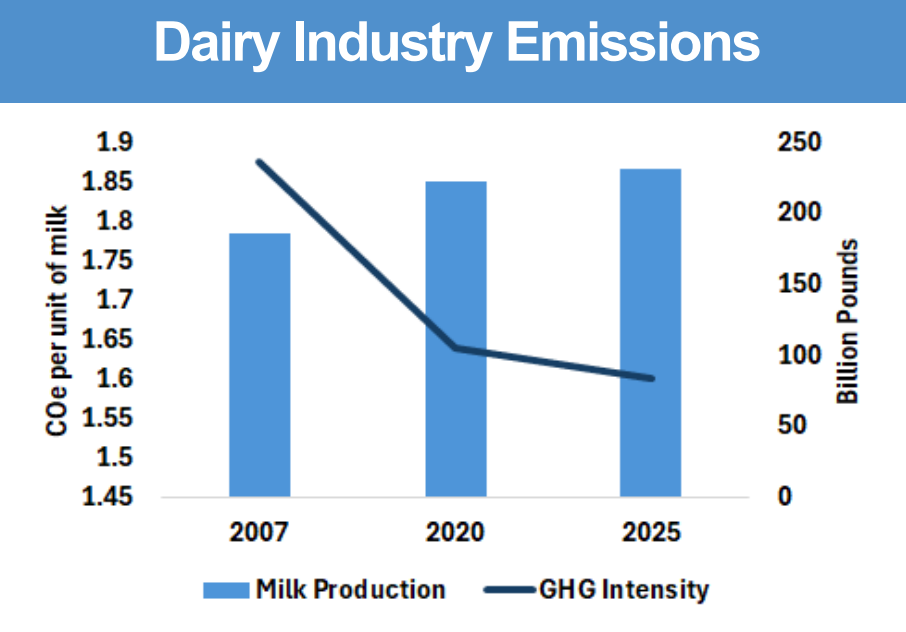
In its commitment to achieve greenhouse gas (GHG) neutrality by 2050, the U.S. dairy industry has become more sustainable while producing increasing quantities of high-quality, nutrient-rich products for a dairyhungry and growing world population. These accomplishments have occurred along the supply change, from feed production to milk production to transportation and finally to processing. Between 2020 and 2025, U.S. dairy’s GHG intensity decreased 2.5%. This progress was the culmination of industry investments in research, technological advancements, and partnerships and collaboration, according to to the Dairy Sustainability Report, published by the Innovation Center for U.S. Dairy. The report documents industry progress and includes the first update on the dairy industry’s 2050 Environmental Stewardship Goals.
Given the relatively short reporting window from 2020 to 2025, researchers conducted a retrospective analysis from 2007 to 2020 to better understand the progress the U.S. dairy industry has made. Over this period, the intensity of GHG emissions associated with fluid milk production decreased approximately 13%, while absolute emissions increased 10%, from 121 million metric tons (MMT) to 132 MMT of carbon dioxide equivalent (CO2e). At the same time, though, milk production increased 27%. Looking at both periods together, GHG emissions intensity associated with fluid milk production decreased 14.7% from 2007 to 2025 while milk production climbed 31%.
Anaerobic digestion, the process by which microorganisms break down manure in oxygen-deprived environments, can effectively reduce GHG emissions while providing renewable sources of natural gas and electricity, the report noted. Over the fiveyear reporting period, virtually all regions saw significant increases in the proportion of dairy manure managed with anaerobic digestion. Notable increases were made in the Pacific Northwest, up from 1.3% to 15.5%, the West, up from 0.6% to 10.5%, and New England, up from 3.5% to 10.5%.
In 2024, dairies used nearly 400 anaerobic digesters. Digesters with biogas capture displaced 1.5 MMT of CO2e in 2025.
Carbon sequestration is another key way to reduce the intensity of GHG emissions. Carbon can be released into the atmosphere when soil is disturbed, while carbon sequestration is the process by which plants absorb CO2 from the atmosphere and store it in the soil. Conservation practices including minimum or no-till and cover cropping foster carbon sequestration. U.S. dairy producers increased carbon sequestration by 5.5% between 2007 and 2020.
In 2017, the industry launched the Farmers Assuring Responsible Management Environmental Stewardship (FARM SE) program to equip producers with resources to track, assess, and communicate environmental achievements. Since its inception, more than 6,000 assessments have been completed on farms with between 10 and 35,000 milk cows. California-based California Dairies, Inc. (CDI) is actively participating in the FARM ES program, conducting evaluations on half of its 280 member farms each year. Two-thirds of CDI’s milk is currently produced on farms with at least one methane-reducing project, and more than 75% of the electricity used on member farms comes from renewable or carbon-free sources.
Dairy processing’s GHG footprint accounts for approximately 20% of the industry’s total. From 2020 to 2025, the absolute GHG emissions from dairy processing decreased by 2.2%.
Dairy continues to do more with less, demonstrating the efficiency and sustainability of the U.S. dairy industry and the strides it has made while helping feed the world.
NMPF NEWS ALERT
- Two cases of New World screwworm were confirmed in Texas last week and two additional cases were confirmed this morning. To help members stay informed, NMPF released a member alert outlining the latest developments and recommended precautions for dairy farms. NMPF has also created a dedicated webpage with the most information and resources related to New World screwworm and ongoing response efforts.
- This week, NMPF’s board of directors is in town for its June meeting. The National Young Cooperators Program is also joining the board for its YC Dairy Policy & Legislative Forum. After two days of preparation, the YCs and board members will head to Capitol Hill on Wednesday to speak with members of Congress and their staffs about ongoing and emerging issues affecting the dairy industry.
Dairy Defined: It’s a GLP-1 world. You need dairy to live in it.
NMPF – June 8
Is he, or isn’t he? Increasingly, he is. With each passing year, GLP-1 receptor agonists used for weight loss and diabetes management (and showing promise in other areas of treatment) are becoming increasingly mainstream, changing the waistlines, health outcomes — and diets — of Americans.
FARM Biosecurity celebrates updated Secure Milk Supply Plan
FARM Program – June 8
The National Dairy FARM Program today celebrates the release of an updated Secure Milk Supply (SMS) Plan, website, and resources, ensuring the health and wellbeing of dairy cattle while preserving the economic viability of dairy businesses. Updates include the expansion of the SMS Plan for Continuity of Business, new resources, and an updated movement permit guidance.
Canada limits U.S. livestock imports, Trump promises lower costs
Agri-Pulse Daybreak (Starts at 00:25) – June 8
It’s another big week as Agriculture Secretary Brooke Rollins grapples with a threat to livestock, senators work on a farm bill, and President Donald Trump says he’s focused on ending war with Iran and lowering costs for ag producers and other Americans. Rollins will travel to Kerrville, Texas, to visit the new Knipling-Bushland U.S. Livestock Insects Research Laboratory, which works to control livestock arthropod pests.
USMCA helps lower U.S. food costs, Purdue study finds
Agri-Pulse Daybreak (Starts at 04:54) – June 8
The trade accord among the U.S., Mexico and Canada has helped keep food prices in check for U.S. families, a Purdue University study finds. Lower tariffs under the U.S.-Mexico-Canada Agreement established in 2020 have led to savings of about $700 a year for U.S. households in today’s dollars, equal to roughly 7% of a home’s total spending on food, according to the report being released today.







.png)


