
U.S., EU Processors Uneasy Over Inflation, Supply🌍
MARKET NEWS
U.S., EU Processors Uneasy Over Inflation, Supply
Daily Dairy Report | May 1, 2026
U.S. and European dairy processors are facing intense cost and margin pressure, despite robust demand growth, according to McKinsey’s eighth annual dairy executive survey, which was expanded last year to include Europe. McKinsey’s report notes that in early 2026, U.S. and European dairy processors were operating in a cost environment defined by persistent inflation, a tight labor force, rising trade and regulatory uncertainties, and supply concerns.
Cost management and volume growth were among the top priorities of U.S. and European dairy executives alike, as persistent inflation and volatile commodity prices continued to compress margins. In the United States, approximately 65% of dairy executives ranked cost management among their top three priorities, up substantially from 2023’s 48%. In Europe, about half said cost containment was among their top three priorities. Rising costs were also apparent in margins. Seven in 10 respondents from the United States reported flat or shrinking margins last year, up from 66% in 2024 and 58% in 2023, while 57% of European respondents reported flat to declining margins last year.
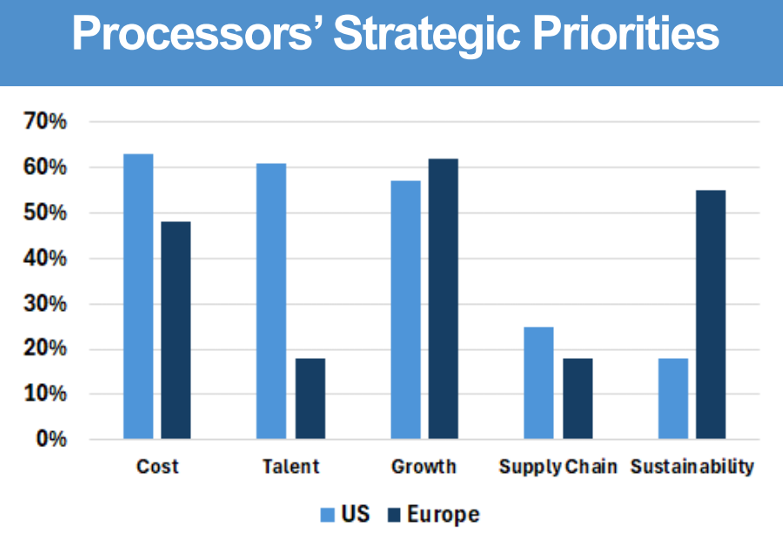
Supply-side risks have also been increasing as dairy producers continue to grapple with various animal health issues, including avian influenza, new world screwworm, and bluetongue disease. In addition, climate-related disruption and structural limitations were limiting milk production growth in parts of Europe. EU respondents cited risk and uncertainty on the supply side as a major issue. One respondent noted that dairy processors see supply and labor availability as intertwined challenges. Moreover, regulatory complexity in Europe and tighter financing have been limiting growth, as has an aging producer population. More than six out of 10 respondents were concerned about the aging dairy producer population.
Several executives noted that the number of farms was declining faster than milk volumes, a “signal of structural fragility beneath near-term production stability,” the report noted. “Quality-of-life considerations and the demanding nature of dairy farming, relative to economic returns, are discouraging new entrants, perpetuating a cycle in which labor availability and supply security increasingly constrain the industry’s growth potential.” Not surprisingly, U.S. dairy companies were more optimistic about growth potential than their European counterparts. In Europe, 40% of dairy executives expected their volumes to remain flat or decline, compared to only about 20% of U.S. respondents.
Looking ahead demand is expected to remain resilient as “consumers continue to prioritize dairy as a primary source of nutrition, sustaining growth in key categories even amid a more cautious macroeconomic backdrop,” the report stated. For executives, McKinsey said “these crosscurrents translate into a clear imperative: protect margins and execution in the near term, while investing selectively behind durable growth themes— most notably, protein-led innovation.”
Despite all the challenges, dairy company executives in both the United States and Europe said they expect their situations to stabilize in the near term, but optimism is stronger in the United States, with U.S. consumer trends supporting that optimism. In the United States, 95% of respondents expect margins to increase compared with a much smaller 76% in Europe. Demand is also expected to remain the highlight for both U.S. and EU dairy executives as high-protein, simple-ingredient, functional foods explode in popularity, a trend that is likely to continue.
The spot nonfat dry milk market slipped this week and dairy futures deflated.
NMPF NEWS ALERT
- The House of Representatives last week approved a long-awaited farm bill. Although the bill’s passage seemed uncertain at multiple points during the week, House leadership ultimately secured enough support to move it forward on Thursday, delivering important victories for dairy farmers and their cooperatives.
- NMPF is hosting its inaugural “Milk Check-In” Wednesday from 2-3 p.m. ET. This new webinar, held quarterly, was created to keep members informed and connected on the issues shaping the dairy industry. Member cooperative staff, dairy farmers and associate members of NMPF can register for the webinar
CEO's Corner: State issues have national implications
NMPF – May 4
Since it began in 1916, the National Milk Producers Federation has been the premier voice for dairy farmers and the cooperatives they own in Washington, offering federal-level and expertise that best serve our members. But Washington isn’t the only, or often even the most important, place where policies originate that affect dairy farmers. State legislatures and regulators take actions that often have implications nationwide.
Farm bill battles begin anew
Agri-Pulse Daybreak (Starts at 04:11) – May 4
Buckle up, because policy fights on pesticide labeling, Prop 12 and E15 are just getting started. Congress is away for the week, giving lobbyists breathing room to reposition for farm bill battles ahead as the House-passed legislation heads to the Senate. Everything except E15, that is.
EPA releases fungicide strategy
Agri-Pulse – May 1
The Environmental Protection Agency has released its draft strategy for determining how growers can minimize harm to endangered species through use of fungicides. The strategy largely follows the frameworks contained in previous blueprints issued for herbicide and insecticide use.
Dairy groups hope for movement with EU
Brownfield Ag News – May 1
The National Milk Producers Federation says the U.S. Trade Representative prioritizing geographical indicators could expand dairy access in key markets. Shawna Morris tells Brownfield the European Union has a more than $2 billion dairy trade deficit with the U.S., in part because of what she says are protectionist policies on common food names.







.png)


