Profits Sink as Costs Rise 📈
MARKET NEWS
Profits Sink as Costs Rise 📈
Daily Dairy Report | October 2, 2026
The Dairy Margin Coverage’s (DMC) income over feed costs calculation fell to $9.34/cwt. in August, the lowest since February 2026. A combination of sinking milk prices and rising feed costs drove the decline. The DMC program allows producers to insure a margin calculated as milk prices less feed costs, using data from USDA’s Agricultural Prices report. Coverage levels range from $4/cwt. to 9.50/ cwt., meaning August’s total triggered a payment for operations that selected the highest coverage.
Looking ahead, on-farm margins are forecast to be under $9.50/cwt. in all but one month through September 2027, with September 2026’s estimate of $7.93/cwt. the lowest. If achieved, September’s margin would be one of the lowest national average margins since the start of 2024. Although dry whey and nonfat dry milk are providing support to both complexes, it has not outweighed the well-below average cheese and butter prices.
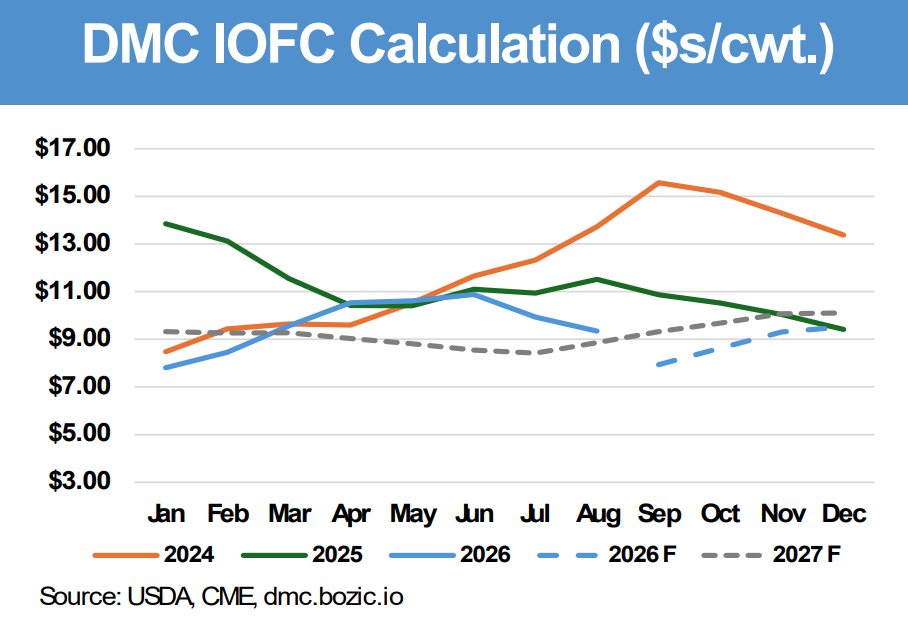
Furthermore, due to El Niño concerns and a poor harvest in Europe, feed costs have been increasing, further compressing profitability. Feed costs are estimated at more than $11/cwt. for the rest of 2026, which would be the highest feed cost average since early 2024. While corn and soybean meal prices have eased over the past month, providing a small bit of relief, they are still much higher than the late-June lows and up from prior-year levels. Hay prices, another factor in the income over feed costs calculation, are higher than a year ago, too.
Cull cow and crossbred calf sales have added to dairy margins over the past year, making 2026’s low milk prices more palatable. This income has provided $4-5/ cwt. additional income over the past year. However, feeder and live cattle prices have dropped, further pressuring on-farm profitability. Although they remain elevated historically, crossbred calf prices at the New Holland, Pennsylvania, auction have fallen 35% since setting a record of $2,041/head in April. This week’s price of $1,312/head is also lower than a year ago. Cull cow prices have decreased, too. DEC ’26 live cattle futures are down from their life-ofcontract highs set in early May by about $20/ cwt., which is also shrinking the bottom line.
Fuel costs are making farm finances harder to pencil out. While not part of the DMC calculation, diesel prices have soared, hitting an all-time high of nearly $6.53/gal. on Sept. 22 and have remained above $6/gal. ever since, according to AAA. For those who grow their own crops, harvest has arrived, and pricey diesel will be used in the fields. These producers could limit plowing and tillage to save on expensive fuel. Dairies that purchase feed will pay high transport costs to bring feed to their operations. While most dairies should have healthy balance sheets because of decent profits over the past two years and additional beef income, producers in Class III and Class IV markets will feel the pain differently. Already, in cheese-heavy regions, mailbox prices are among the lowest in the country and well below the All-Milk price. The income over feed costs calculation uses the national All-Milk price for milk revenue, and thus does not reflect the impact of lower individual mailbox prices. Class IV operations are faring better, and those in markets with Class I exposure are experiencing the “higher of” advanced skim pricing, which is limiting losses. That said, recent price changes in both income and expenses for dairy producers have hurt profitability, and on-farm finances are closer to breakeven than they have been since 2023.
NMPF NEWS ALERT
- Last week at World Dairy Expo, House Agriculture Committee Chairman GT Thompson joined NMPF President & CEO Gregg Doud for a fireside chat on the policy issues shaping dairy's future. Chairman Thompson remains optimistic that Congress will pass a farm bill during the lame duck session after the election and he is still pushing for the inclusion of his Securing Agriculture's Workforce Act (H.R. 9535) on any legislation that might be moving yet this year.
- Today is the first day to sign up for 2027 Dairy Margin Coverage (DMC). The Oct. 5– Dec. 18 sign-up period was announced by USDA Secretary Rollins at World Dairy Expo last week. Contact your local Farm Service Agency office for more information.
CEO's Corner: The fight for flavored milk
NMPF – Oct. 5
I know that nutrition, especially involving American kids, is a hot button issues these days, and it’s one that people care deeply about. They deserve clear information to help them make good choices. It’s frustrating to me that flavored milk is getting a bad rap when so many children are drinking beverages with known stimulative effects, artificial additives, and minimal nutrition. So, I wanted to step back and ask a simple question: what are the facts?
USTR opens public comment on USMCA
Agri-Pulse Daybreak (Starts at 03:38) – Oct. 5
The Office of the U.S. Trade Representative has opened up the 2027 joint review of the United States-Mexico-Canada Agreement for public comment. This marks the second review of the key North America trade agreement, which is critical to supply chains and agricultural trade.
U.S. states challenge Corteva spinoff as evading PFAS liabilities
Reuters – Oct. 1
Fifteen US states sued agrichemicals company Corteva on Thursday, alleging that the spinoff of its seed and genetics business into Vylor was designed to shield the company's best assets from tens of billions of dollars in potential liabilities tied to PFAS "forever chemicals" that have polluted the environment.