More Milk Leads to Higher Inventories 🥛
MARKET NEWS
More Milk Leads to Higher Inventories 🥛
Daily Dairy Report | September 25, 2026
As milk continues to flow across the United States, inventories of certain dairy products have been accumulating. The situation has become particularly marked for butter. According to USDA’s Cold Storage report released this afternoon, at the end of August, nearly 315.67 million pounds of butter were held in storage. While down from July’s levels, stocks were a whopping 10.3% larger than a year earlier, following the typical seasonal pattern. However, the build-up represents a significant departure from recent months. In July, inventories were a mere 0.3% larger than a year earlier, and before that, volumes had been running below prior-year levels since March 2025.
Much has been written about the increase in U.S. fat supplies in recent months and years. As milk production has expanded and fat tests have risen, the market has found itself well supplied with milkfat. Butter production has thrived on the available cream with 2026 output up 5.9% through July compared to the same period a year ago. Meanwhile, butter demand has remained robust with domestic disappearance up 4.6% and exports rising to a record-large 147.3 million pounds between January and July. Since March, though, strong production has outpaced demand, pulling the spot price steadily lower. The situation has intensified, and the spot butter price slipped into the $1.30s before recovering slightly to close today’s session at $1.40/lb.
This month’s Cold Storage report seems to suggest that the market has plenty of butter to work through before prices can recover in earnest.
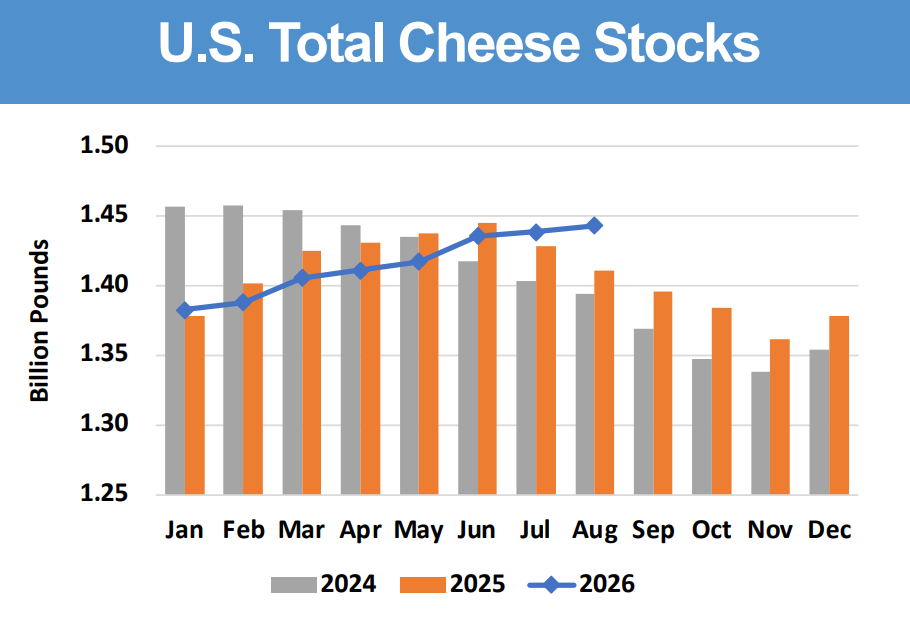
Butter isn’t the only product piling up in storage. Cheese inventories are also running ahead of prior-year levels. At the end of August, an estimated 1.443 billion pounds of cheese was in storage, 2.3% more than at the same time last year. Following a similar trend, the year-over-year increase in cheese stocks is significantly more pronounced than in recent months. Most of the increase has been due to rising stocks of other cheese, which includes Italian varieties like Mozzarella. Stocks of the other cheese category were up 4.5% year over year, reinforcing the notion that cheese demand from foodservice channels has been poor. American cheese inventories were also up compared to August 2025, albeit by a much more modest 0.5%.
Cheese production has also remained upbeat this year, with volumes up 2.4% through August. And while record-large exports now account for about 13% of production, the vast majority of cheese produced in the United States is consumed domestically. Importantly, over the last few months, domestic cheese consumption has started to slow with disappearance down 1% in July. Facing economic pressure, consumers pulled back on eating out a while ago. But new data suggests that retail sales of cheese have started to weaken, as well. With domestic demand sliding and stocks accumulating, the cheese price is coming under pressure. The block Cheddar spot price lost 4.25¢ this week sliding to $1.3075/lb. on Friday. Without any fundamental shifts to either supply or demand, cheese stocks will likely continue to grow, potentially lending further weakness to the market.
NMPF NEWS ALERT
- Last Wednesday, NMPF joined a broad coalition of farm, business and shipping groups in a letter urging U.S. Trade Representative Jamieson Greer to keep port fees on Chinese-built ships on hold past their Nov. 9 expiration. NMPF pushed for the original pause last year because those costs would fall on U.S. dairy exporters, which is still the case.
- The comment period for FARM Program Version 2028 updates closes Friday. Proposed changes to the Animal Care and Workforce Development programs include how injured tails are evaluated, Fitness to Transport guidelines, calf nutrition documentation and clearer wording on the workforce development side. Share your feedback here.
Senators take aim at chemicals in food packaging with new bill
Agri-Pulse Daybreak (Starts at 05:48) – Sept. 28
Sens. Maggie Hassan, D-NH, and Tommy Tuberville, R-AL, are proposing a bill to ban “forever chemicals” used to repel grease and liquids in some food wrappers and packaging. The bill would bar the use of food packaging containing intentionally added PFAS in interstate commerce by Jan. 1, 2028.
Krysta Harden on the outlook for U.S. dairy
Agri-Pulse Newsmakers – Sept. 25
This week on Agri-Pulse Newsmakers, Sen. John Hoeven of North Dakota discusses the path ahead for the farm bill. He tells host Tammi Arender he believes it will be passed before the lame duck session of Congress ends. Dan Basse of AgResource examines the meeting between President Trump and Chinese President Xi Jinping, while Krysta Harden of the U.S. Dairy Export Council joins the conversation on issues facing the dairy industry.
Higher milk components deliver bigger paychecks for dairy farms
Wisconsin State Farmer – Sept. 28
A new report from CoBank found dairy herds in the top 10% for milk components earned substantially more revenue per cow than lower-component herds, highlighting the increasing value of butterfat and protein in today's dairy marketplace. According to theanalysis, top-decile herds earned an additional $101 to $352 per cow annually at average U.S. production levels.
EU agriculture ministers meet as rising oil prices threaten farmers
Bloomberg – Sept. 28
Further European Union emergency support for the bloc’s agriculture sector depends on how market conditions develop, after extreme heat over the summer, according to the Ireland’s Agriculture Minister Martin Heydon. “It does depend on a number of factors,” Heydon said in an interview with Bloomberg Television, when asked whether the EU would need to go further than measures already announced. “Europe I think stands ready to support our agriculture sector” He added.