More Fat Makes Exports More Crucial 🧈
MARKET NEWS
More Fat Makes Exports More Crucial 🧈
Daily Dairy Report | September 18, 2026
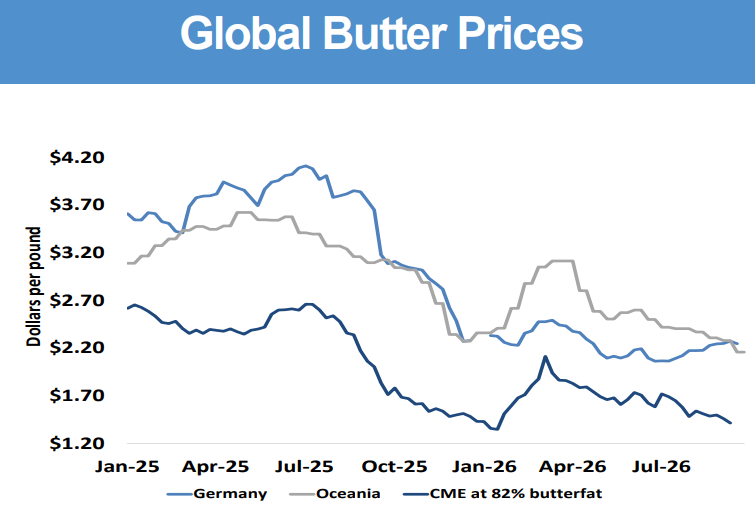
CME spot butter prices are historically weak, settling at $1.37/lb. in today’s session. Typically, butter prices rally late in the third quarter and early into the fourth as retailers fill holiday orders, but that has not been the case so far in 2026. October butter futures settled at $1.4105/lb. in yesterday’s trade, an extremely low price for October when the peak is usually set. Currently, the September butter price average is $1.3844/ lb., which if it holds, would be the lowest value for any September since 2009, during the Great Recession when the lowest milk prices of the modern era were posted. Looking at monthly averages back to 2001, just five years—2009, 2007, 2006, 2003, and 2002—have seen September prices averaging under $1.40/lb. Notably, all of these years are all from the first decade of the 21st century, suggesting a structural change after the 2009 financial crisis and changing attitudes toward the consumption of butterfat.
The increased fat-test levels of the past five years are one reason for today’s depressed prices. July’s fat test, using data from USDA’s Agricultural Prices report, registered at 4.19%, up 1.5% from July 2025, but the five-year growth rate of 7.2% is more impressive. From 2000 to 2010, fat test levels did not grow. The annual average fat test for 2000 was 3.68%, and by 2010, it was 3.66%, hovering around those marks throughout the decade. Advances in nutrition and genetics, along with new strategies for optimizing milk checks, drove an increase in fat tests starting in 2010. The next decade saw fat tests grow to 3.95% by 2020, up 7.9% from 2010. However, over the past five years, year-over-yearincreases have continued, and in 2025, the annual mean was 4.32%, up 9.4% in just five years. Add in growing U.S. milk volumes, and from 2020 to 2025, milkfat output grew by almost 1.2 billion pounds, enough to make an additional 1.5 billion pounds of butter.
USDA’s Supply and Allocation report shows cheese as the largest user of milkfat, soaking up more than 40% of the total, with butter ranking second with 18-19%. New U.S. cheese plants are absorbing some of the increased butterfat, leaving other commodities to pick up the rest. Butter churns have run hard over the last few years, too, lapping up the extra cream by increasing output each year by over 5% in 2024, 2025, and through July 2026, but plenty remains.
U.S. butter prices have declined from $3/lb. or more in 2022, 2023, and 2024, and have been cheaper than Europe and New Zealand through nearly all the past two years. This price advantage has led to larger U.S. butter exports, with four months over the past year ranking in the top-10 for volume. That said, the discount is eroding as the global milkfat market melts down. A year ago, U.S. butter was priced at discount of over $1.25/lb. to European and New Zealand prices, but the discount is now closer to 90¢. Due to the double whammy of the large growth in the fat test and total collections, exports are critical to keeping CME butter prices from cratering further.
Domestic utilization takes about 95% of total churn volume, which has been quite strong in 2026, with several months setting all-time highs in USDA’s Supply and Utilization data. Retail butter prices are lower than a year ago, which is helping keep U.S. demand lofty. However, with butter prices as low as they are, and fat supplies as large as they are, both engines—exports and domestic consumption—need to fire to lift prices.
CME spot cheese settled at $1.35/lb. today, its lowest September price since 2009.
NMPF NEWS ALERT
- The Senate Agriculture Committee passed a version of the 2026 farm bill on Wednesday, but it is unclear whether the full Senate will take up a vote before its next recess begins in early October. The House unexpectedly adjourned last week until Nov. 9, after midterm elections.
Farmers want relief from Congress. Here’s the holdup.
Washington Post – Sept. 19
Farmers are struggling under the pressure of higher energy costs, tariffs and fluctuating crop prices. Congress wants to help but has been deadlocked for three years on how to do so. Now, lawmakers are the closest they have come in nearly eight years to getting a new farm bill done. The Senate Agriculture Committee voted Wednesday to advance its bill to the full Senate. The House passed its bill in April.
Sticker shock at U.S. diesel pumps continues to worsen
Agri-Pulse Daybreak (Starts at 00:23) – Sept. 21
A weekend wave of violence has the world bracing for a possible new jump in oil prices. A massive Ukrainian drone strike in the Moscow region left a major Russian oil refinery ablaze, while the Iran-backed Houthis say they attacked oil facilities in Saudi Arabia, the world’s largest exporter of crude oil. The U.S. is the top overall oil producer.
Opinion: The future of agricultural data must remain public
Agri-Pulse – Sept. 18
Farmers and ranchers rely on public data every day. Weather forecasts guide planting and harvest decisions, disease monitoring systems help protect livestock, and production estimates help farmers decide when to sell, hedge, borrow and invest. Producers depend on a constant stream of field and market data, yet the public systems that underpin those data are currently under strain due to federal staffing shortages, institutional re-alignments and budget cuts.
New Mexico ag officials announce expanded surveillance following screwworm case
Source NM – Sept. 20
New Mexico agriculture officials on Friday confirmed expanded surveillance following the Sept. 17 detection of a second New World screwworm case, afflicting a horse in Grant County. The officials said that routine animal movement won’t be restricted unless an inspector identifies higher-risk situations.