
Healthy Kids Act Pulls Up Some Milk Sales 🥛
MARKET NEWS
Healthy Kids Act Pulls Up Some Milk Sales 🥛
Daily Dairy Report | August 7, 2026
Not surprisingly, fluid milk sales continue to tend lower, but some categories are showing strong growth. While total yearover-year May sales dropped 2.1% as the nation’s schools let out for summer, the drop in year-to-date sales of total conventional products dipped only 0.4%, with just over 16.5 billion pounds of milk sold in the first five months of the year, according to data from USDA’s latest Fluid Milk Sales report.
While total conventional sales were down 2.2% in May, sales in four categories of fluid products posted decent-sized gains. Flavored whole milks posted the largest increase in sales, with May sales up 11%, compared to a year earlier, and year-to-date sales climbed 14.5%, likely the result of the Whole Milk for Healthy Kids Act that allowed schools to serve whole white and flavored milks in school feeding programs beginning January 1.
The second-largest sales gain was in the other fluid milk products category, which consists of lactose-free, ultrafiltered, and other specialty milks as well as drinkable yogurts and kefir. Year-to-date sales of these products were up 13.9%, while year-overyear sales in May soared 24.1%. Year-todate white whole milk sales rose 2.4%, but year-over-year sales were up only 0.1%. Buttermilk sales were up 0.8% year to date despite falling 2% in May.
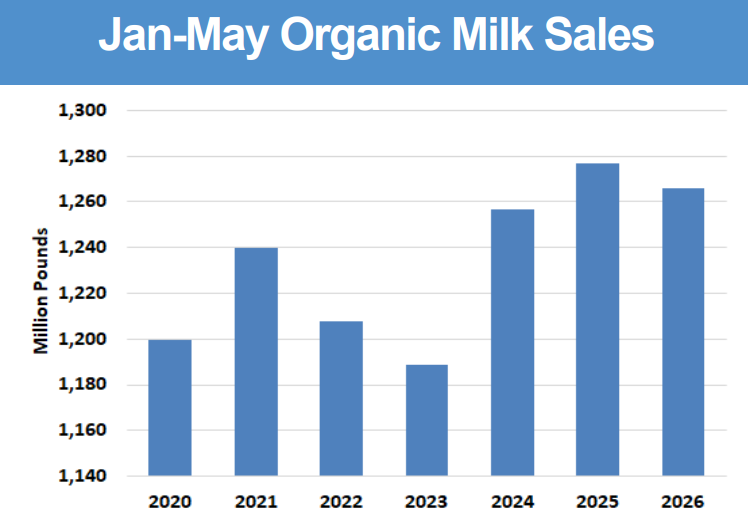
Organic milk sales, however, did not fare as well, and sellers of organic milks are not happy. Year-to-date organic milk sales through May fell 0.9%, and only organic whole and whole flavored milk sales were in positive territory, up 3.3% and 27.7%, respectively. Sales in all other categories fell between 3.6% for reduced fat milk and 92.1% for other organic milk products.
In late April, the Coalition for Organic Dairy Exemption filed three separate court actions against the federal government that question the constitutionality of requiring their participation in the Federal Milk Marketing Order (FMMO) program.
The coalition, which consists of Organic Valley, Aurora Organic Dairy, CROPP Cooperative, and Horizon Organic Dairy, seeks exemption from FMMOs and compensation for their members who have paid into federal order pools without benefiting from them. In addition, seven producers from across the country filed a class action takings claim against the government that seeks compensation for six years of payments made into federal order pools. They argue that because a larger share of organic milk than conventional milk is used as Class I, organic producers have a net obligation to the pools.
Organic Valley Vice President of Government and Industry Affairs Adam Warthesan told Wisconsin Public Radio that that since 2006, more than $400 million has been paid into FMMO pools by organic processors and redistributed primarily to conventional producers. “For a co-op like Organic Valley, that’s tens of millions of dollars a year that are being taken out of our farmers pockets,” he said.
While the issue has been ongoing, Warthesan noted that his co-op’s payments into the pool have increased 60% since USDA implemented updates last year to the FMMO program. Those changes were the impetus behind April’s first-ever legal action the coalition has taken against the FMMO program. In 2015, organic processors submitted proposals to USDA that did not advance, then in 2023, they presented USDA with organicspecific recommendations during a national FMMO hearing that were not included in the final rule. And their administrative challenges filed in 2025 were opposed.
More than 10% of U.S. dairy farms are certified organic and organic milk represents close to 3% of milk production while accounting for roughly 7% of fluid milk sales by value.
NMPF NEWS ALERT
- The Senate Agriculture Committee failed to advance the Agricultural Act of 2026 out of committee last week, as senators could not reach agreement on SNAP costshare provisions. The bill failed with 10 Republicans voting in favor and 11 Democrats voting against.
- The Senate adjourned for a five-week recess early Saturday morning and are not due to return to Washington until Sept. 14.
Dairy Defined Podcast: Dairy farmers near win in decades-long regulatory fight
NMPF – Aug. 10
The Emergency Planning and Community Right-to-Know Act, aka EPCRA, was created in 1986 to help communities plan for chemical emergencies. It requires industry to report on the storage, use, and release of hazardous substances to federal, state, and local governments. It’s a good law, NMPF Chief Counsel Clay Detlefsen said in the latest Dairy Defined Podcast, but unintended consequences have snared dairy farmers into a decades-long fight against over-regulation.
Senate confirms Smith as USDA rural development undersecretary
Agri-Pulse – Aug. 7
The Senate has confirmed Glen Smith to be undersecretary for rural development, filling a position that has been vacant since January 2025. Smith is a board member and formerCEO of the Farm Credit Administration who had his hearing in November. The Senate Agriculture Committee advanced his nomination in June.
FDA authorizes wound spray to help protect against screwworm
Texas Public Radio – Aug. 8
Texas ranchers and wildlife managers now have a new tool to help protect animals from New World screwworm, as the parasitic fly continues to spread in the state. The FDA has issued an Emergency Use Authorization for CLiK Extra, a wound spray that can help prevent New World screwworm infestations in livestock and several species of wildlife.
Farmers bred a new kind of cow designed to maintain solar farms
BGR – Aug. 8
Agrivoltaics is a growing practice that involves using land occupied by solar panels for agricultural purposes, such as raising crops and grazing livestock. It's a mutually beneficial way to get the most use out of the land, and grazing sheep on solar farms has become a great source of income for farmers. But it's been harder to get solar companies to agree to let cattle onto their land, which is why farmers Jess and Marcus Gray of Gray's LAMBscaping came up with a solution: breeding a new kind of cow.







.png)


