
Dairy Product Inventories Slim 🥛
MARKET NEWS
Dairy Product Inventories Slim 🥛
Daily Dairy Report | July 24, 2026
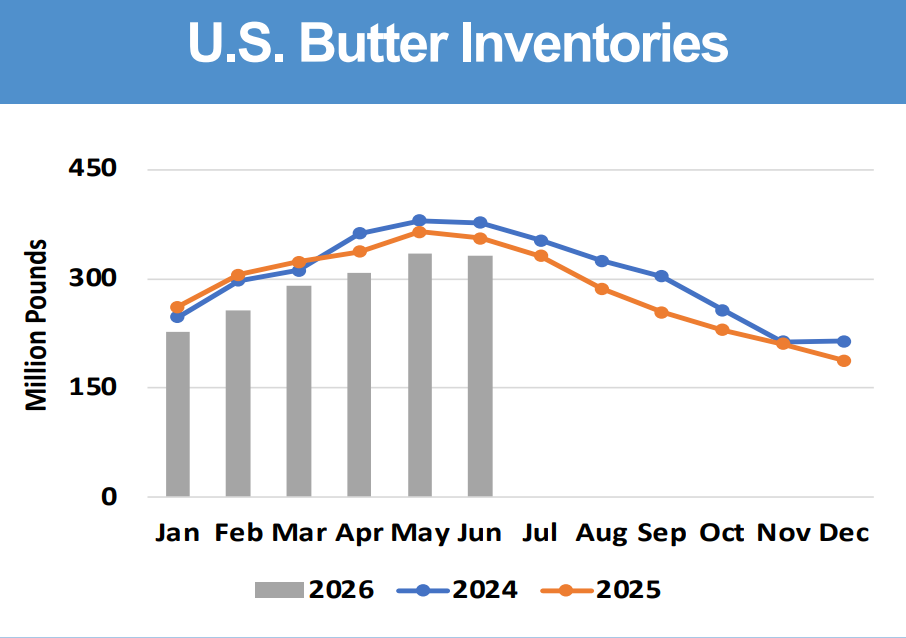
Despite persistently strong milk production and dairy product output, upbeat demand has been keeping inventories in check. According to USDA’s Cold Storage report released this afternoon, 332.13 million pounds of butter were held in storage at the end of June. This represented a 1% decrease compared to the prior month, which was in line with typical seasonal trends. Furthermore, butter stocks were 6.6% lighter than at the same time last year, but the gap has narrowed compared to earlier months. While high milkfat values in raw milk have kept cream available to churns, record-strong butterfat exports have prevented butter from accumulating in storage.
A similar scenario has played out in cheese markets, where record-large cheese exports have played a critical role in moving expanding production offshore. As a result, total cheese stocks were 1.433 billion pounds at the end of June, 0.8% less than at this time last year. However, cheese stocks grew 1.1% between May and June, a stronger seasonal gain than in recent years and the strongest May to June jump since 2015.
American cheese stocks were up 1.2% vs. the prior month, although they trail prior-year levels by 1.7%. Cheese manufacturers have been reticent to produce American cheese varieties, especially Cheddar, in recent months because spot prices have been falling. Meanwhile, inventories of other varieties of cheese, which include popular Italian styles, rose 0.2% year over year and 1.3% month over month. Producers of Italian cheese, especially Mozzarella, have capitalized on rising global cheese demand, pushing exports upwards. However, today’s inventory numbers confirm that ample output has ensured that product is readily available.
A growing dairy herd has been one of the key factors pushing milk production higher, and it appears this trend will persist, according to USDA’s Cattle report released this afternoon. As of July 1, there were 9.65 million head of milk cows and heifers that have calved in the United States, 200,000 more than at the same time last year. The national dairy herd is now the largest in more than 30 years as producers actively retain cows for an extra lactation cycle, while crossbreeding for beef calves to take advantage of sky-high beef prices.
Although some concern previously circulated that high beef prices were going to keep heifer numbers limited, replacement heifer inventories of 3.6 million head as of July 1 were up 100,000 head compared to a year earlier. There had also been some discussion over the veracity of the numbers included in the biannual Cattle report, but from any angle, the U.S. dairy herd is large and poised to continue expanding into the future.
Markets softened across the board this week as dairy product supplies continue to outpace demand. Butter took the biggest dip, sliding 8.25¢ from last Friday to $1.5075/lb. as a sizeable 77 loads of product traded hands. Nonfat dry milk prices also continued their descent, with the spot price landing at $1.4025/lb. at the conclusion of today’s session, 6.75¢ lower than last Friday. Spot Cheddar blocks gave up 2¢ over the week to end Friday’s session at $1.6075/lb., while dry whey wrapped up the week at 68¢ per pound, down 1.5¢ compared to last week’s price.
NMPF NEWS ALERT
- The White House announced last week that President Trump is imposing a 50% tariff on certain imports from Canada, including some dairy products, invoking Section 338 of the Tariff Act of 1930 to hold Canada accountable for what Ambassador Greer called its ongoing "retaliation and discrimination" against U.S. commerce.
Dairy Defined: Whole Milk x 5 = The Importance of Trade
NMPF – July 27
Fact: Getting whole milk back in school meals this fall is a big deal. Thanks to the Whole Milk for Healthy Kids Act and demand from parents across the country, the most popular variety of milk in the United States is back on lunch trays, benefiting the next generation of milk drinkers.
USDA to reopen southern border cattle trade
Agri-Pulse – July 24
The USDA announced that it will begin a phased reopening of southern ports for livestock trade starting in Arizona with full inspections to ensure the animals are free of any signs of new world screwworm. The USDA’s Animal and Plant Health Inspection Service detected the first case of new world screwworm in the U.S. in June. There have been 42 domestically acquired animal cases, according to APHIS.
America’s obsession with whey protein has a delicious consequence: More cheese
NBC News – July 25
America’s protein obsession is helping push U.S. cheese production to record highs, as booming demand for whey reshapes the dairy industry. As consumers load up on whey protein, dairy processors are making more cheese and exports are helping absorb the growing supply.
Ag groups react favorably to Section 301 tariff exemptions
Agri-Pulse – July 24
The Trump administration's exemptions for agricultural inputs such as fertilizer and seeds from tariffs imposed on 60 countries drew praise from the agricultural industry. The Officeof the U.S. Trade Representative concluded its quick Section 301 investigation Thursday into allegations that 60 countries have not properly enforced prohibitions against importation of products made using forced labor. The action came just hours before global 10% tariffs imposed under Section 122 were set to expire.







.png)


