
Converging Factors Wallop Markets 📉
MARKET NEWS
Converging Factors Wallop Markets 📉
Daily Dairy Report | July 17, 2026
Several typical and atypical events have converged to impact milk production and product mix in the United States in July. The month started with a massive heat dome that blanketed much of the country. While the second week of the month brought a reprieve, heat and humidity returned this week. Cows in the Upper Midwest and the Great Plains have struggled with the common symptoms of heat stress, including reduced feed and water intake, increased respiration and heart rate, and elevated body temperature— symptoms that result in lower milk output, lower pregnancy rates, and a greater propensity for disease. While cooling strategies like fans, misters, and shade can help in sweltering temperatures, they become less effective as humidity rises.
According to the University of Minnesota, cows begin to experience heat stress when temperatures exceed 72° F. and humidity exceeds 50%. Using these values as the baseline, the university created a Temperature-Humidity Index (THI) to track stress levels from mild to severe. A 2025 paper published in Food Policy noted that for every unit increase in THI above 72, about 1% of milk volume is lost. The paper also noted that just one day of heat stress can impact cow health for up to a week, and that multiple days or events can compound losses. So, while summer heat and humidity are a normal part of the annual lactation curve, extreme weather events, like the current ones, can cause greater seasonal milk depression than average summer weather.
Commentary from Dairy Market News confirmed the loss, stating that milk and component levels in the Central region have been falling in the heat. Availability of spot milk has also slowed, and the basis on Upper Midwest spot loads has been holding above the five-year average. If hot temperatures persist, this trend will continue, tightening milk supplies ahead of the start of the school year, when a strong Class I pull occurs.
Wildfire smoke has also drifted into many areas already affected by heat and humidity. Wildfires in southern Ontario and the Boundary Waters Canoe Area in northern Minnesota continue to burn. Air quality in Detroit, Chicago, and Minneapolis, all located in states with large dairy cow populations, was among the worst on the planet yesterday. While less is known about the effects of wildfire smoke on milk production, a 2022 article in the Journal of Dairy Science analyzed a small sample of dairy cows exposed to smoke. The study found that wildfire smoke elevates inflammation and respiratory strain, reducing feed intake and lowering milk volume. Thus, in areas affected by both tropical weather and hazardous air quality, the drop in milk yields was likely even steeper.
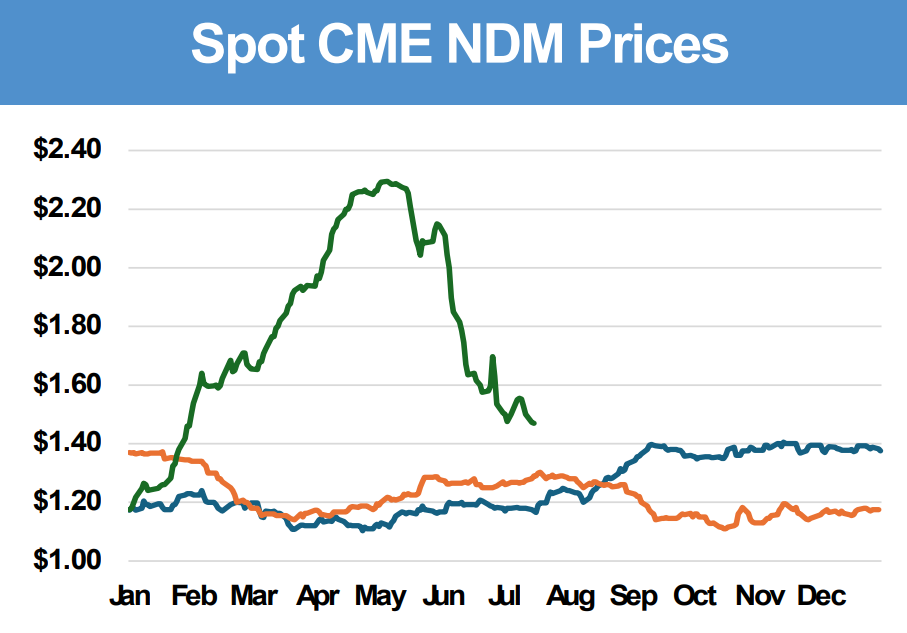
In other news, Fairlife’s U.S. operations have been temporarily suspended due to a cyberattack. That has likely put more condensed skim milk on the market in Arizona, New York, and Michigan, where Fairlife operates plants. The unexpected increase in skim solids will head to milk dryers, pushing nonfat dry milk (NDM) prices lower, at least temporarily. However, given Fairlife’s popularity, once plants are operational again, they likely will run overtime to keep product on the shelf. In other words, the impact could be a short-term blip of lower prices and higher NDM output in July, followed by tighter supplies and a swing higher in the basis for spot milk as plants resume operations.
The cumulative effect of these three events will intensify market reactions, shift product mixes, and influence milk supply and availability far more than any one of them alone would have done. Summer is only half over, and additional disruptions or weather events could still emerge, each potentially bullish for the market.
NMPF NEWS ALERT
- Nearly 50 dairy advocates from across the country were in town and on Capitol Hill last week for NMPF’s State Dairy Association Summit, wrapping up Wednesday with roughly 50 meetings between farmers, association leaders, and Hill staff and lawmakers. Discussions covered everything from truck weights, investment tax credits and data centers to House Agriculture Committee Chairman G.T. Thompson's agricultural labor reform legislation, with advocates making a strong push for a workable labor system for dairy farmers.
Falling butterfat prices bring relief to the freezer aisle
CNN – July 19
Ice cream prices are cooling off at the cash register ahead of National Ice Cream Day. Even as summer heat drives up the demand for frozen treats, the average price of a halfgallon ice cream container in the US was below $6 last month, according to data released Tuesday by the Bureau of Labor Statistics.
Coca-Cola halts U.S. Fairlife milk production after cyberattack
Inc.com – July 19
A ransomware attack has curdled Coca-Cola’s dairy operations. In a disclosure filed with the U.S. Securities and Exchange Commission this week, the multinational giant said its Fairlife dairy company was hit by a ransomware attack, affecting its production systems and temporarily suspending Fairlife’s operations across the U.S. for the foreseeable future.
Product of USA label gains momentum
Successful Farming – July 20
Quality Assurance & Food Safety Magazine’s Jacqueline Mitchell reported that, “ten meat and poultry companies have recently adopted the U.S. Department of Agriculture’s(USDA) voluntary Product of USA label, identifying meat, poultry, and egg products from animals that are born, raised, harvested and processed in the United States. USDA launched a nationwide awareness campaign about the label earlier this year.”






.png)


