
Beef Calf Values Drop 🥩
MARKET NEWS
Beef Calf Values Drop 🥩
Daily Dairy Report | July 30, 2026
Dairy producers are bracing for much slimmer on-farm margins than those they enjoyed in the first half of this year, as higher feed costs and a slump in milk prices take a deeper bite out of their bottom lines. And a steep drop in calf values promises to further reduce dairy revenues.
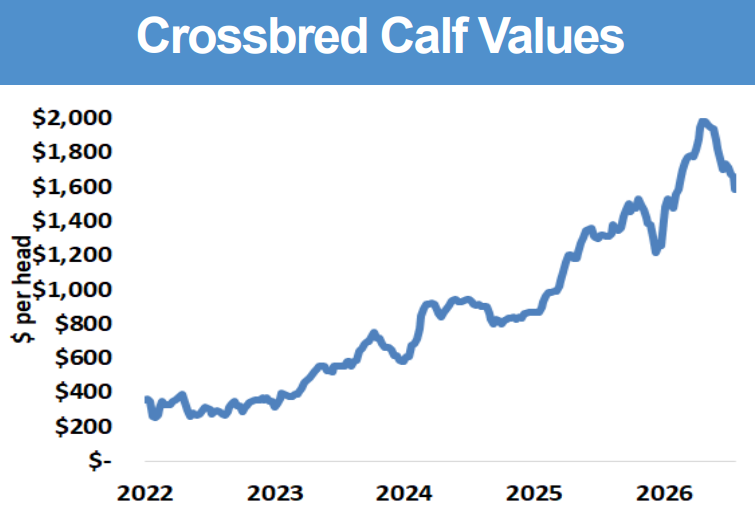
The beef industry remains short of young livestock, and the dairy industry is a valuable source of calves. But consumer pushback on pricey beef, severe drought in the West, and USDA’s plans to open the border to Mexican feeder cattle have all weighed on the price of young beef cattle. Beef-on-dairy crossbred calf values peaked in June, when producers could sell newborn calves for $1,800 to nearly $2,000/head, depending on the region. Today, calves are worth about $400 less, and futures prices for feeder cattle suggest values will continue to drop. A typical dairy breeding program produces enough dairy heifer calves to maintain the milking herd. But more than half of the calves born on the dairy are extras, and today nearly all of these are beef-on-dairy crossbreds. Assuming national average cull rates, death loss, and breeding practices, the roughly $400 drop in crossbred calf values since their June peak will reduce dairy revenues by about $1.25/ cwt. of milk production.
Even after the recent decline, beef calf revenues represent a substantial revenue stream for dairy producers. So far this year, they’ve contributed the equivalent of more than$5/cwt. of milk production for the average Holstein dairy, up from less than $4/cwt. last year and around $2.70 in 2024. Before 2023, beef calf revenue added less than $1/cwt. to dairy producers’ net revenues. Calf sales will continue to play an important role in shielding dairy producers from the impact of lower milk income and higher feed costs. But with all three commodity markets moving adversely for on-farm margins, one dairy producer recently told the Daily Dairy Report, “Making milk will be a lot less fun.”
NMPF NEWS ALERT
- NMPF and the U.S. Dairy Export Council wrapped up the eighth annual U.S.Mexico Binational Dairy Summit last week in Querétaro, Mexico, where we joined leading Mexican dairy organizations to reaffirm shared commitment to trade, innovation and the future of dairy farming in both countries.
- Senate Agriculture Chairman John Boozman has scheduled marking up the farm bill on Thursday, the last scheduled workday before the chamber breaks for summer recess.
CEO's Corner: The past year has been a great NEXT year
NMPF – Aug. 3
Here’s something to celebrate: The NMPF Export and Trade (NEXT) program is one year old, and already it’s a critical part of dairy’s export success. NEXT is a voluntary, U.S. dairy product sales overseas and seeks a better alignment of supply and demand for milk and milk products at home. Member cooperatives provide the funding for NEXT by contributing two cents per hundredweight of milk marketed.
Americans are rethinking their love affair with plant milks
Bloomberg – Aug. 3
Alternative milks entered the mainstream in force in the 2010s. Now customer preferences are shifting again. Retail sales by volume of dairy-free milks have fallen by more than 5% each year for three straight years, according to data from market researcher Circana. Almond milk has been among the hardest-hit, but even oat milk, which long reigned as the coolest milk on the block, has seen momentum slow.
New Senate farm bill includes SNAP cost delays, year-round E15
Agri-Pulse – July 31
The Senate Agriculture Committee released revised farm bill text that would delay state cost-sharing requirements under the nation’s biggest nutrition program as well as allow year-round access to higher ethanol fuel blends at U.S. gasoline pumps. The updated "Farm Bill 2.0, the Agricultural Act of 2026" calls to extend the timeline for states to "restore the integrity" of SNAP benefits through "improved administration that reduces payment error rates," the committee said in a statement on Friday evening.
Feeding dairy cows to be more resilient to infection
Virginia Tech News – July 31
New research focuses on strengthening cows’ immune systems through nutrition to address rising disease rates and industry challenges. Assistant Professor Johan Osorio studies how naturally occurring bioactive compounds can improve dairy cow health during calving, improving immune function, milk production, and herd health.






.png)


