
Argentina Production Ticks Up in May
MARKET NEWS
Argentina Production Ticks Up in May📈
Daily Dairy Report | June 18, 2026
Argentina’s milk production growth rebounded in May, rising by 2% year over year and recording the largest volume for the month in more than a decade. After tumbling in 2024 due to economic pressures, milk production in the South American country grew by a dramatic 9.9% in 2025, bolstered by favorable weather and strong producer margins. This trend carried into early 2026 with production during the first quarter up 9.4% compared to the elevated volumes of the same period last year. However, production gains nearly ground to a halt in April as excess rainfall and wet weather weighed on cow comfort. As a result, May’s increase, though modest compared to the gains witnessed over the last 18 months, represented an important return to stronger year-over-year growth.
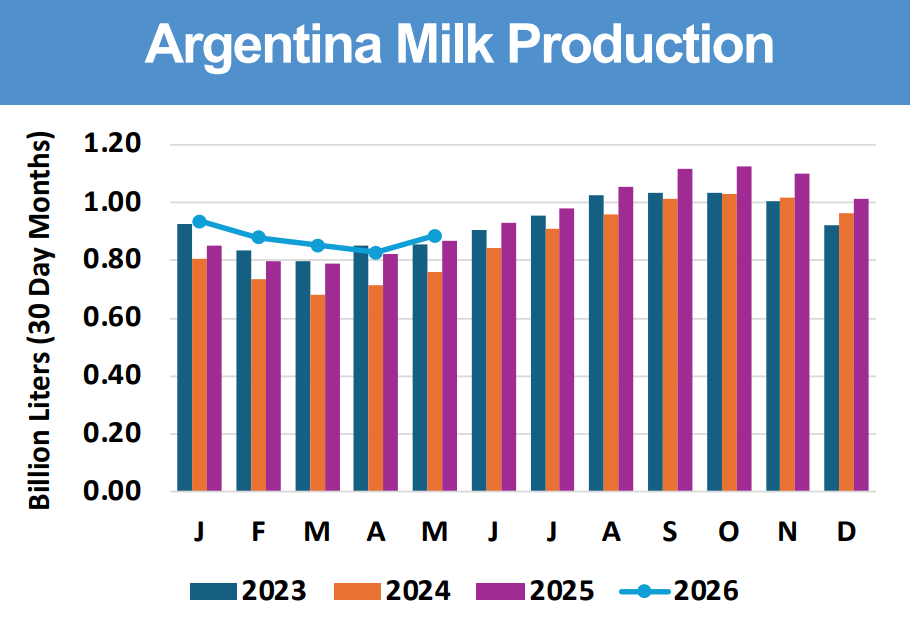
Milk production in Argentina is expected to continue to post similarly modest gains over the balance of the year, though headwinds are fierce. Margins are considerably narrower so far in 2026 but a recent uptick in the milk price is helping to stem some of the economic pressure on producers. Higher input costs, especially for fertilizer, are also expected to impact producer profitability, though the recently improved outlook for peace in the Middle East is helping to quell some of these concerns.
Another risk to milk production comes from the impending El Niño weather phenomenon, which is all but certain to dominate through the balance of the year. An El Niño typically brings increased precipitation to Argentina’s main dairy regions. If rainfall is excessive, it can reduce forage availability and hurt animal wellbeing, which can negatively impact production. Furthermore, the country continues to grapple with poor infrastructure, and heavy rains can wash out roads and cause serious logistical headaches for the sector. Argentina is one of South America’s major exporters and as milk production rises, even modestly, it should result in an increased availability of dairy solids for the global market.
NMPF NEWS ALERT
- The Trump administration released guidance that gives dairy farmers clarity on how they can use the H-2A visa program, confirming that dairy work can qualify for H-2A workers when a farm can show it has a temporary or seasonal labor need. NMPF will work with advocates in Congress to continue working for a labor system that fully meets industry needs.
Dairy Defined Podcast: Ultra-processed foods definition elusive
NMPF – June 22
What, exactly, is an ultra-processed food? Proposals about, and FDA may be weighing in. But figuring out what a definition should and shouldn’t cover is a difficult task, Chad Galer, vice president of product innovation and food safety for Dairy Management, Inc., said. “I think it’s a risk that it might be a bit oversimplified,” he said. “It should be more of a matrixed approach where you are balancing the nutrition and the processing.”
Agri-Pulse Open Mic features USDEC’s Krysta Harden
Agri-Pulse – June 21
This week's Open Mic guest is Krysta Harden, President & CEO of the U.S. Dairy ExportCouncil. Sales of dairy products in North America and around the globe have seen exponential increases over the past few decades. Harden discusses renewal of the USMCA trade agreement, proposed language in a new farm bill that would improve the outlook for dairy farmers and the International Year of the Women Farmer.
USDA reports three new cases of screwworm, bringing total to 15
Reuters – June 21
The number of U.S. cases of New World screwworm has risen to 15 after three more animals tested positive in Texas, the Department of Agriculture said in a post on social media on Sunday. The USDA announcement comes nearly three weeks after the first domestic screwworm infestation in six decades was found in a Texas calf.
Congress is anxious as U.S.-Canada-Mexico trade talks intensify
New York Times – June 19
As another round of negotiations to review a North American free-trade deal wraps up in Washington this week, lawmakers are growing more vocal in defense of the deal, and anxious about its future. President Trump has said he’s not sure whether he will renew the six-year-old United States-Mexico-Canada Agreement.







.png)


